PhD Thesis: Optimization of Neural Network Topology Based on Neuroevolutionary Algorithms Using Distributed Parallel Computations.
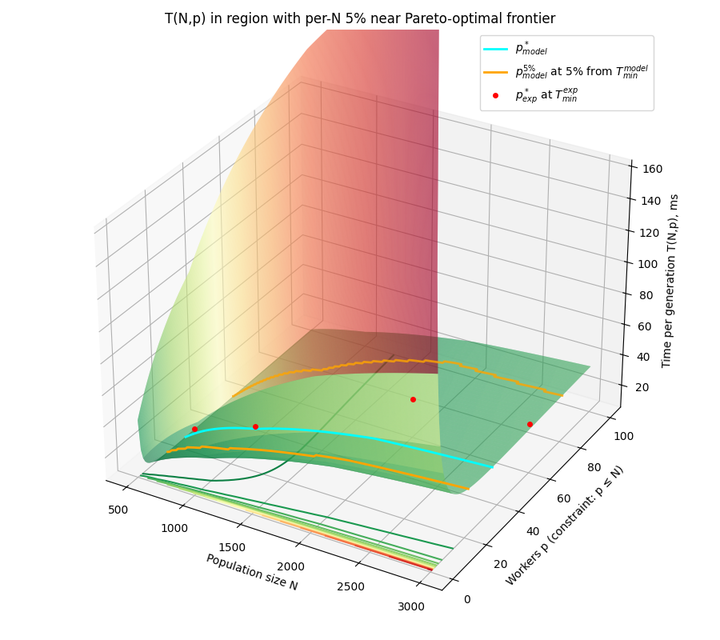 Three-dimensional dependence of the total evolution time on the population size N and the number of workers p, with the Pareto-optimal region highlighted (within 5% of the minimum evolution time for each population size).
Abstract
The dissertation is submitted in partial fulfillment of the requirements for the degree of Doctor of Philosophy (PhD) in the specialty 122 – “Computer Sciences”. The research was carried out at the Institute of Software Systems of the National Academy of Sciences of Ukraine.
The dissertation is devoted to solving a relevant scientific and applied problem of improving the performance (speed) of artificial neural network (ANN) topology construction using the NEAT neuroevolutionary algorithm by optimizing the fitness evaluation stage through the application of parallel computing techniques.
Neuroevolutionary algorithms, like other genetic algorithms, are based on the concept of evolutionary development of a population of organisms encoding the topology and/or weight coefficients of a neural network. To maintain the evolutionary process, each organism in the population must be evaluated by a selected fitness function at every evolutionary epoch. Typically, the fitness function relies on parameters obtained by simulating a practical task that each organism in the population must solve. Classical software models for managing the evolutionary process in neuroevolutionary algorithms perform such simulations sequentially for each organism before generating the next population. This approach has a significant negative impact on algorithm performance, since practical task simulation usually requires substantial computational resources and execution time. As a result, the total computation time grows proportionally to the population size, leading to a considerable loss of efficiency and limiting the applicability of neuroevolutionary algorithms to real-world problems involving complex simulations of physical environments. This limitation is particularly critical given that neural network topologies obtained via neuroevolution are typically optimal and energy-efficient, making them suitable for deployment on resource-constrained devices such as autonomous robotic platforms and unmanned aerial vehicles.
The described performance issue can be mitigated by employing modern software tools that enable parallel execution of task simulations in a distributed computational environment. This dissertation proposes a software-based approach for utilizing distributed parallel computations at the stage of practical task simulation used for fitness evaluation in neuroevolutionary algorithms.

Dr. Iaroslav Omelianenko
CTO/Research Director
My research interests include genetic algorithms/neuroevolution, synthetic cognitive systems, smart environment, and cooperative robotics.